
Vol. 5 No. 51 | Dec. 17, 2025


Courts
- 2025 OK 91: REV. DR. MITCH RANDALL, ET AL. V. LINDEL FIELDS, ET AL.
- 2025 OK 92: IN RE: RULES OF THE SUPREME COURT FOR MANDATORY CONTINUING LEGAL EDUCATION
- 2025 OK 93: STATE OF OKLAHOMA EX REL. OBA V. HOUSLEY
- 2025 OK 94: STATE OF OKLAHOMA EX REL. OBA V. SPIELMAN
- 2025 OK 96: STATE OF OKLAHOMA EX REL. OBA V. MORRIS
No published opinions this week.
- 2025 OK CIV APP 37: IN THE MATTER OF S.L.M.W., MASON V. HALL
Dispositions Other than by Published Opinions
The Supreme Court of Oklahoma Court Calendar
The Supreme Court of Oklahoma is in session year round, unless otherwise noted. The court regularly schedules conferences on Mondays and other days as needed.
Member Transitions







More

The Oklahoma Bar Association is currently closed in observance of the Christmas holiday. We will reopen at 8:30 a.m. on Monday, Dec. 29.
The OBA will also be closed Jan. 1-2 in observance of the New Year's Day holiday.
With all of December's hustle and bustle, we know things can get a little hectic! As you wind down to the end of the year, don't forget to earn the rest of your CLE hours. OBA CLE has dozens of online CLE programs to choose from through WebCredenza.
Just visit the website to access online OBA CLE programs, available anywhere – and even better, on your own time. You can even search the webpage to discover topics most relevant to you.
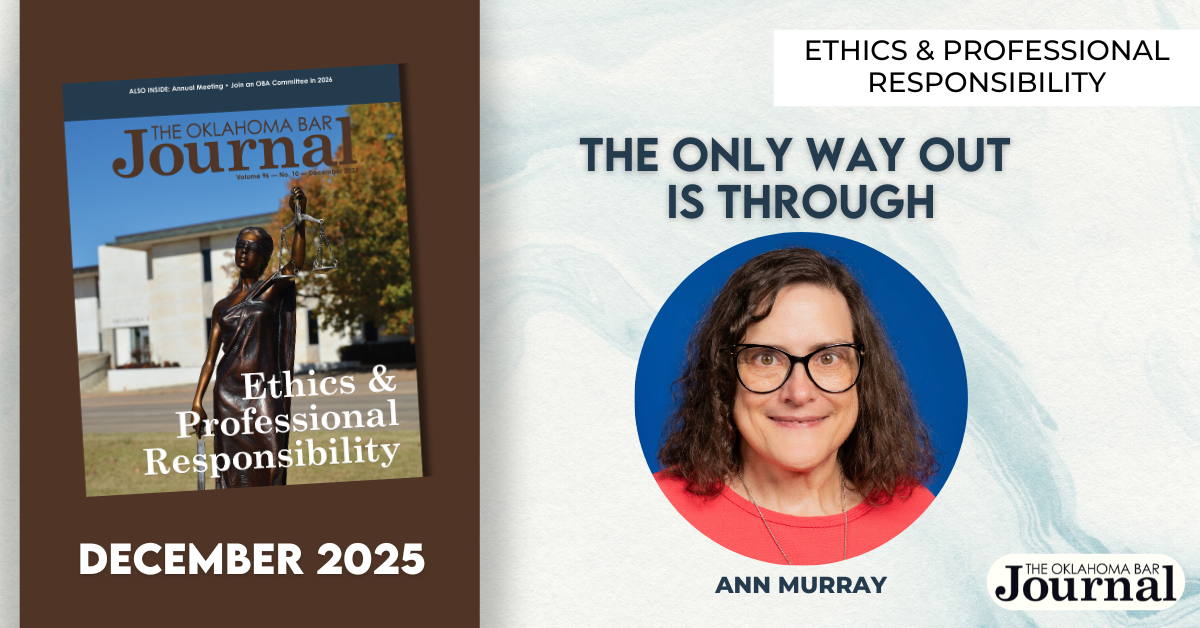
"Nationwide, research suggests that nearly 28% of attorneys experience depression, and about 19% live with anxiety.[1] Those numbers are troubling – but this isn’t a story about statistics. This is a story about one lawyer’s journey through the fog and weight of depression.
It is my story.
Over the years, this journal has published courageous, honest articles from attorneys dealing with addiction, like Scott B. Goode’s piece in December 2020.[2] I admire the courage it takes to speak openly about such personal battles. Today, I’m attempting to do the same – not to dwell on my own pain but to shine a light on a truth too many of us keep in the shadows: Mental illness is widespread in our profession, and the stigma around it must end."
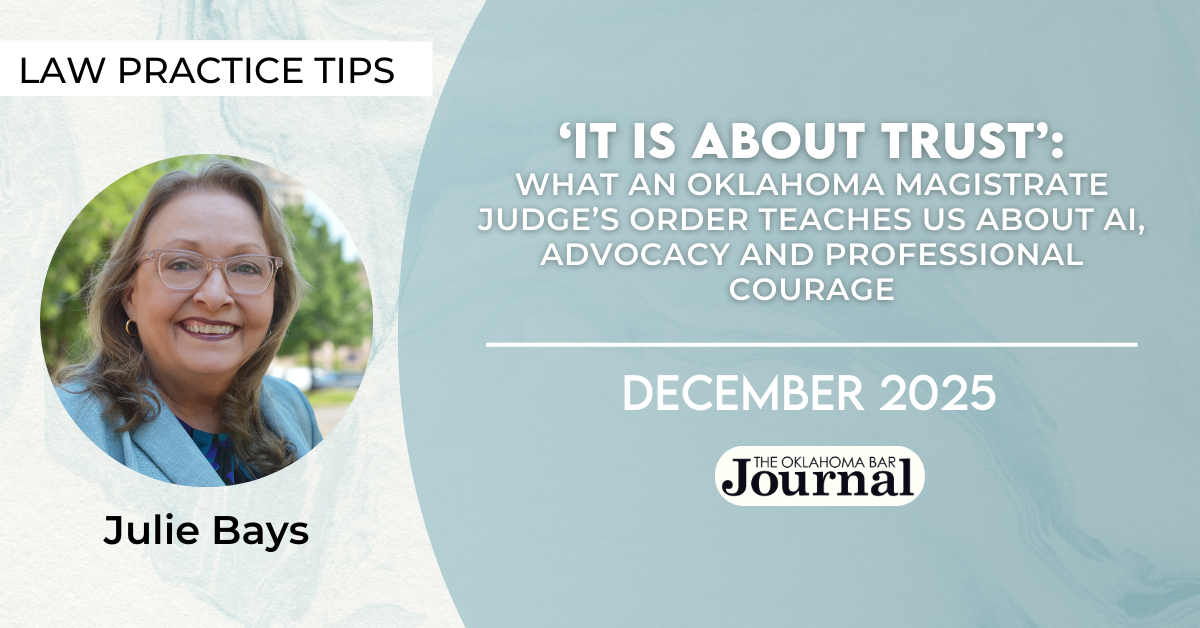
"The most impactful court orders serve not only to resolve motions but also to provide valuable teaching moments. An Oct. 22 order from U.S. Magistrate Judge Jason A. Robertson in the Eastern District of Oklahoma does exactly that. It’s a careful, unsparing explanation of what went wrong when counsel filed briefs laced with fabricated citations and misstatements, and it’s also a roadmap for how lawyers should engage with generative AI without surrendering the duties that make advocacy trustworthy."

On Nov. 20, a three-judge panel was appointed to serve on the Court of Existing Claims (CEC) Division of the Court of Civil Appeals. Their terms will begin Jan. 1.
This panel consists of:
- Presiding Judge Robert D. Bell
- Judge Thomas E. Prince
- Judge Jane P. Wiseman
- Judge James Huber (Alternate)
This panel will serve through Dec. 31, 2026.

The annual OBA Law Day Art and Writing Contest is designed to stimulate discussion and understanding of the law among young Oklahomans. Categories include art and writing for grades pre-K through 12th, with prizes up to $500 and plaques for winners, plus participation certificates to honor every student's hard work. The 2026 theme is “The Rule of Law and the American Dream.” The deadline for students to submit their entries is Friday, Jan. 23.
Featured CLE




By OBA Management Assistance Program Director Julie Bays
 A question I hear more frequently as lawyers begin experimenting with generative AI is a simple one: If technology allows me to do the work faster, can I still charge a reasonable fee?
A few weeks ago, on Nov. 24, the Supreme Court of Virginia approved a new ethics opinion that squarely addresses that question. While the opinion applies only to Virginia lawyers, it is a timely and thoughtful discussion of how long-standing fee principles apply when lawyers use productivity-enhancing tools, like generative AI.
Virginia’s opinion makes one point clear: Reduced time does not automatically mean reduced value. When lawyers use AI to work more efficiently, the ethical analysis does not stop at the clock. Skill, judgment, experience, results obtained and the ability to properly supervise and verify AI output all remain part of what clients are paying for.
Oklahoma has not issued an ethics opinion specifically addressing AI and fees. However, Oklahoma Rule 1.5 already requires that fees be reasonable and adequately explained, considering factors far broader than time alone. Those factors include the complexity of the matter, the lawyer’s experience and ability and the results achieved.
This discussion is not new. For years, I have encouraged lawyers to explore flat fees, limited scope services and other value-based billing models, particularly as technology continues to reduce the time required for most routine legal tasks. Many clients prefer predictable pricing, and many lawyers find these models better reflect how legal services are actually delivered today. I also regularly address this issue in CLE programs on AI, where efficiency gains raise important questions about transparency, communication and billing expectations.
The takeaway is not that hourly billing is obsolete, nor that AI changes our ethical rules overnight. Instead, technology is pushing lawyers to think more carefully about how they explain the value they provide and how their fee structures align with client expectations.
The Oklahoma Bar Journal is a publication of the Oklahoma Bar Association. All rights reserved. Copyright© 2025 Oklahoma Bar Association. Statements or opinions expressed herein are those of the authors and do not necessarily reflect those of the Oklahoma Bar Association, its officers, Board of Governors, Board of Editors or staff. Although advertising copy is reviewed, no endorsement of any product or service offered by any advertisement is intended or implied by publication. Advertisers are solely responsible for the content of their ads, and the OBA reserves the right to edit or reject any advertising copy for any reason. Legal articles carried in The Oklahoma Bar Journal are selected by the Board of Editors. Information about submissions can be found at www.okbar.org.