
Vol. 6 No. 6 | Feb. 11, 2026


Courts
Supreme Court of Oklahoma
- 2026 OK 5: THE HONORABLE KENDAL SACCHIERI et al., v. SERVICE OKLAHOMA
- 2026 OK 6: STATE OF OKLAHOMA ex rel., OBA v. LILE
- 2026 OK 7: CACTUS DRILLING CO. LLC, v. THE HONORABLE KORY KIRKLAND, and FAULKNER, et al.
- 2026 OK 8: In re: AMENDMENTS TO RULE 2 OF THE RULES FOR MANDATORY JUDICIAL CONTINUING LEGAL EDUCATION
Court of Criminal Appeals
- 2026 OK CR 2: JACOBS v. STATE
- 2026 OK CR 4: STATE v. CRAWFORD
- 2026 OK CR 5: BATTEE v. STATE
- 2026 OK CR 6: RADFORD v. STATE
Court of Civil Appeals
No published opinions this week.
Dispositions Other than by Published Opinions
The Supreme Court of Oklahoma Court Calendar
The Supreme Court of Oklahoma is in session year round, unless otherwise noted. The court regularly schedules conferences on Mondays and other days as needed.
Member Transitions



More
Bar Center Holiday Hours

The Oklahoma Bar Center will be closed Monday, Feb. 16, in observance of Presidents Day.
From the February Bar Journal:
The Administrative Side of Driving While Under the Influence

"'A person’s claim to a driver’s license is a protectable property interest that may not be terminated without due process of law under the United States Constitution. Oklahoma’s Constitution provides no less protection.'
Every driver operating a motorized vehicle on a public road has agreed to follow a few rules. They have agreed to obey 'the laws of the road' by following traffic signs and stoplights and operating their vehicles with due care. Drivers implicitly agree to abstain from engaging in reckless conduct or being inattentive while operating their vehicles."
From the Executive Director: Write On!
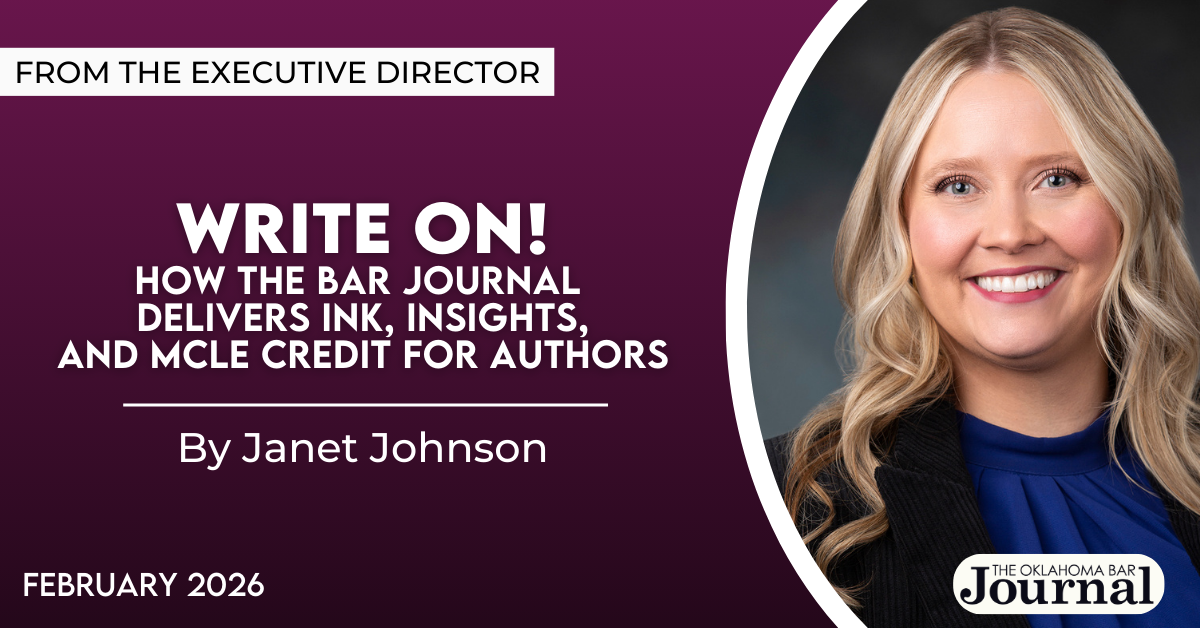
"Why is our association’s journal so important? It is the opportunities it provides members to learn and grow in their profession, both as readers and as authors. There is a professional obligation for lawyers not only to represent clients but also to contribute to the strength, integrity, and education of the legal profession. One of the most effective ways attorneys can fulfill this responsibility is by sharing their professional and subject-matter expertise through articles published in scholarly journals and bar association publications, like the Oklahoma Bar Journal. These contributions benefit fellow practitioners, improve the quality of legal discourse, and strengthen the profession as a whole. And as of Jan. 1 of this year, there is an even greater benefit to authors. A recent rule change approved by the Supreme Court ensures that Oklahoma lawyers who author scholarly articles published in the Oklahoma Bar Journal will earn 6 hours of MCLE credit. That translates to half of your required credit hours for an entire year. That is what I call a win-win!"
Tuesday, Feb. 17: MCLE Deadline,
Dues Are Due

DUES ARE DUE | The deadline to pay your 2026 OBA membership dues without a late fee is Tuesday, Feb. 17. Please make your dues payment today! Visit your MyOKBar page to remit dues online.
MCLE DEADLINE APPROACHING | The deadline to earn your required credit for 2025 was Dec. 31. The deadline to report your earned credit or a qualified exemption for 2025 is Tuesday, Feb. 17. Unless you are reporting an exemption, the minimum annual requirement is 10 general credits and 2 ethics credits for a total of 12 credits. All credit must be OK MCLE approved. To access your MCLE information, log in to MyOKBar and click "MyMCLE." Still need credit? Check out great CLE offerings at ok.webcredenza.com. If you have questions about your credit, email mcle@okbar.org.
Apply Now for an Oklahoma Bar Foundation Court Grant

The application period for Oklahoma Bar Foundation court grants is now open. Through these grants, the Oklahoma Bar Foundation helps improve the administration of justice in district and appellate courtrooms across Oklahoma. Grants may be used to fund courtroom technology equipment, such as interactive display boards, audio systems or video equipment. Courts can apply now through March 9.
Featured CLE



Why Your Law Firm Website Needs To Speak Like Your Clients
By OBA Management Assistance Program Director Julie Bays
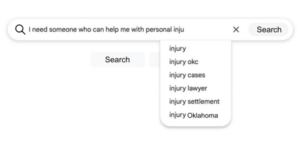 Lately, I have been having more conversations with lawyers who are worried that their "website just isn’t working like it used to.” They are not imagining it.
The way people search for lawyers is changing, and it is changing because the way people search for anything is changing.
Annette Choti recently wrote a piece on law firm marketing trends for 2026 that really hit on something important. Not because it lists tools or tactics, but because it explains the why behind what many of us are already noticing: Traditional Google search behavior is no longer the whole story.
Two of her points really stood out to me.
First, search is evolving into what she calls AI answer engines. People are no longer just typing keywords into Google and scrolling through blue links. They are asking questions in ChatGPT, Copilot, Gemini, Siri and Alexa. They are asking with full sentences. They are asking very specific questions. And they are expecting a direct answer, not a list of websites.
That changes everything about how a law firm gets “found.”
These tools do not rank websites the same way Google did for years. They pull from content that clearly answers questions, from trusted sources, from sites that demonstrate real authority. If your website is built around “We are a full-service law firm serving the greater metro area,” you are invisible to this kind of search. If your website answers real client questions in plain language, you are suddenly much more visible.
Second, voice search is no longer a novelty. People are talking to their phones, their cars and their home devices. And when they speak, they do not use the same language they type. They ask, “What do I do if my employer won’t pay me?” not “wage claim attorney Oklahoma City.”
That means the content on law firm websites needs to sound more like how clients talk and less like how lawyers title practice areas.
These two shifts together explain why some lawyers feel like their marketing stopped working. It did not stop working. The environment around it has changed.
Ms. Choti's article goes on to discuss several other trends that are worth a read, but these two points alone are enough to make most of us rethink how we describe our services online and how we structure the content on our firm websites.

The Oklahoma Bar Journal is a publication of the Oklahoma Bar Association. All rights reserved. Copyright© 2026 Oklahoma Bar Association. Statements or opinions expressed herein are those of the authors and do not necessarily reflect those of the Oklahoma Bar Association, its officers, Board of Governors, Board of Editors or staff. Although advertising copy is reviewed, no endorsement of any product or service offered by any advertisement is intended or implied by publication. Advertisers are solely responsible for the content of their ads, and the OBA reserves the right to edit or reject any advertising copy for any reason. Legal articles carried in the Oklahoma Bar Journal are selected by the Board of Editors. Information about submissions can be found at www.okbar.org.