
Vol. 6 No. 33 | Aug. 19, 2026


Courts
Supreme Court of Oklahoma
No published opinions this week.
Court of Criminal Appeals
No published opinions this week.
Court of Civil Appeals
- 2026 OK CIV APP 27: MAYO v. TULSA TOUGH, INC.
Dispositions Other than by Published Opinions
The Supreme Court of Oklahoma Court Calendar
The Supreme Court of Oklahoma is in session year round, unless otherwise noted. The court regularly schedules conferences on Mondays and other days as needed.
Member Transitions






More
Register Now for This Week's Legislative Debrief on Aug. 21
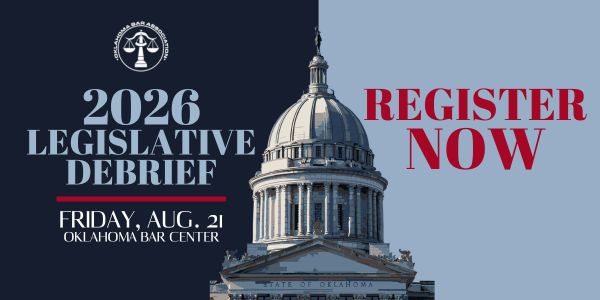
The annual Legislative Debrief is an opportunity for OBA members to hear the latest updates on legislation that may impact their legal practices. This year's agenda will include a legislative panel as well as the always informative "90 Bills in 90 Minutes" session featuring updates on legislation impacting legal practice in Oklahoma. There is no cost to attend, and 3 hours of MCLE credit are available. Walk-in registration will be available.
New MyOKBar Coming Soon!

Upgrades are coming soon to MyOKBar! Members can expect a refreshed, modern design that will be more streamlined and user friendly. As we prepare for the rollout of the new and improved site, MyOKBar will be read-only Aug. 25-Sept. 8. The member directory and SSO features will be available, but members will be unable to make changes to their information on file. Visit Visit www.okbar.org and click “MyOKBar Login” to update your information now.
From the August Bar Journal: Insurance Law and The Tax Stamp as Drug Law

Why We Are All Insurance Lawyers
By Paul Kouri
"Some have said that insurance law should be a required course in law school because it touches so many areas of legal practice. This article aims to convey that point: every attorney – no matter their preferred practice area – should also understand how insurance affects their practice."
Tax Stamp as Drug Law in Action
By Kat Albrecht, Corey Boyd, Samuel Galoob and Stephen Galoob
"In November 2016, Oklahoma voters approved State Question 780, which made the offense of 'Possession of Controlled Dangerous Substance' (simple possession) a misdemeanor but did not change any other drug laws or penalties. Oklahoma prosecutors vigorously opposed SQ 780 in the runup to the 2016 election, arguing that it would deprive them of crucial tools that they needed to promote public safety."
Law Practice Tips | Your Client Is Already Using AI. Now What?

"Lawyers have spent the last few years discussing how artificial intelligence can be used in the practice of law. That discussion is important, but it is no longer the only AI issue in the attorney-client relationship. Clients are also using AI. They are using it before they call a lawyer, after they hire a lawyer and sometimes while litigation is pending. They may use AI to understand a demand letter, summarize a contract, draft a statement, evaluate a claim, prepare for a meeting or decide whether they think their lawyer is doing a good job.
This behavior is understandable. Legal problems are stressful. Clients want immediate answers. AI tools are available, easy to use and often presented as conversational helpers. But when clients use public or consumer AI tools for legal problems, they may create risks they do not understand. They may disclose confidential facts. They may input privileged communications into a third-party platform. They may create prompts and outputs that become relevant in discovery. They may rely on inaccurate legal analysis. Or they may create a written record that complicates the lawyer’s ability to advise them later."
Volunteer Your Legal Expertise To Support America's Heroes

Make a difference this Veterans Day by volunteering to provide pro bono legal services to those who serve our nation and our communities every day. Volunteer registration is now open!
Heroes Day | Nov. 11 | Oklahoma City
The inaugural Heroes Day event, planned for Veterans Day, Nov. 11, at the Oklahoma Bar Center in Oklahoma City, will offer free, in-person legal assistance for military service members and veterans from 10 a.m. to 2 p.m. A wide range of legal services will be offered to address the varying needs of those who have honorably served our nation. Lunch will be offered and CLE will be available. Contact Tiffani Armendariz with the Oklahoma Access to Justice Foundation for more information.

Featured CLE




Should Lawyers Use AI Notetakers?
By OBA Management Assistance Program Director Julie Bays
 In my August Oklahoma Bar Journal Law Practice Tips article, I wrote about clients using AI tools, including AI notetakers. That got me thinking about the other side of the conversation. Lawyers are beginning to use these tools too.
Some AI notetakers join an online meeting as another participant. Others are built into platforms such as Microsoft Teams or Zoom. One product receiving attention from lawyers is Plaud, which offers small recording devices, including a wearable version. The device captures a conversation or voice note, and its accompanying AI service produces a transcript and summary.
It is easy to understand the attraction. A lawyer can concentrate on the conversation instead of trying to listen, ask questions and take detailed notes at the same time. Afterward, the lawyer may have a searchable transcript, a meeting summary and a ready-made task list.
Recording an entire client meeting is not the only possible use. A lawyer could dictate notes immediately after a hearing, organize thoughts for a brief, summarize a conference or capture ideas while preparing for a presentation. Beginning with your own voice notes can be a relatively low-risk way to determine whether the technology actually saves time.
QUESTIONS BEFORE YOU RECORD
Before recording conversations with other people, however, lawyers should consider more than convenience. Oklahoma generally permits recording with the consent of one party, but participants in an interstate call may be located in states with different requirements. Obtaining everyone’s consent is the safest practice and helps avoid surprising a client or colleague.
Lawyers must also protect client information. Before using an AI notetaker, investigate where recordings and transcripts are stored, who can access them, how long they are retained, whether they can be permanently deleted and whether the provider may use the information to train its AI. The free and paid versions of the same product may offer different protections.
Finally, review every transcript and summary. AI can misidentify speakers, misunderstand names or legal terminology, omit important context and assign a task to the wrong person. A polished summary is not necessarily an accurate one. Firms should also decide whether recordings, transcripts and summaries will become part of the client file and how long each will be retained.
For a practical discussion of recording laws and the risks associated with these tools, read Ernie Svenson’s “AI Note-Takers for Lawyers: The Recording Risk You Need to Fully Understand.”
For a closer look at confidentiality, privilege, informed consent and clients bringing their own notetakers into meetings, read Mark Palmer’s “When AI Notetakers Enter Your Client Meetings: Ethical Duties and Risks for Lawyers.”
The Oklahoma Bar Journal is a publication of the Oklahoma Bar Association. All rights reserved. Copyright© 2026 Oklahoma Bar Association. Statements or opinions expressed herein are those of the authors and do not necessarily reflect those of the Oklahoma Bar Association, its officers, Board of Governors, Board of Editors or staff. Although advertising copy is reviewed, no endorsement of any product or service offered by any advertisement is intended or implied by publication. Advertisers are solely responsible for the content of their ads, and the OBA reserves the right to edit or reject any advertising copy for any reason. Legal articles carried in the Oklahoma Bar Journal are selected by the Board of Editors. Information about submissions can be found at www.okbar.org.