
Vol. 6 No. 46 | Nov. 18, 2026


Courts
Supreme Court of Oklahoma
No published opinions this week.
Court of Criminal Appeals
No published opinions this week.
Court of Civil Appeals
No published opinions this week.
Dispositions Other than by Published Opinions
The Supreme Court of Oklahoma Court Calendar
The Supreme Court of Oklahoma is in session year round, unless otherwise noted. The court regularly schedules conferences on Mondays and other days as needed.
Member Transitions
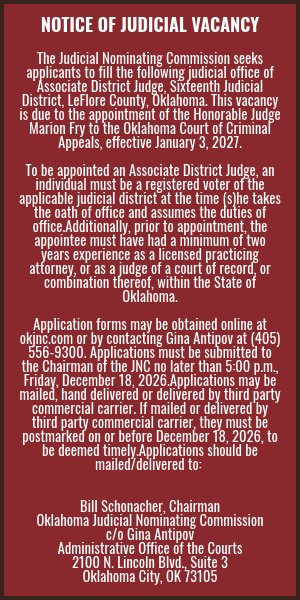







More
2027 OBA Leadership and Transitions
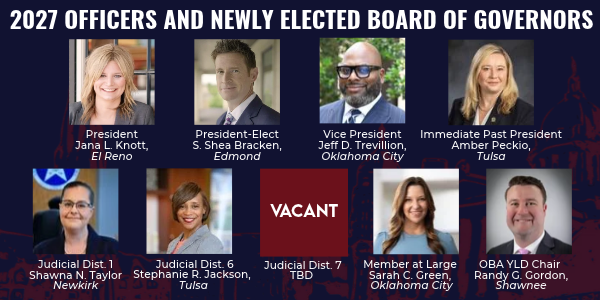
The Oklahoma Bar Association announced its 2027 officers and newly elected Board of Governors members on Friday, Nov. 13, during the OBA’s 122nd Annual Meeting in Oklahoma City at the Skirvin Hilton Hotel.
El Reno attorney Jana L. Knott will serve as the Oklahoma Bar Association’s 2027 president, following a year as president-elect. She will lead the OBA’s 17-member Board of Governors, which meets monthly and governs the association.
S. Shea Bracken of Edmond was elected to serve as president-elect for 2027, and Jeff D. Trevillion of Oklahoma City will serve as vice president. Amber Peckio of Tulsa, who served as the 2026 OBA president, will remain on the Board of Governors for one year as the immediate past president.
Also elected to the OBA Board of Governors to represent their respective Supreme Court judicial districts are Shawna N. Taylor of Newkirk and Stephanie R. Jackson of Tulsa. They will serve three-year terms. Sarah C. Green of Oklahoma City will also serve a three-year term as a member-at-large. Randy G. Gordon of Shawnee will serve a one-year term as OBA Young Lawyers Division chairperson.
New officers and Board of Governors members will take office Jan. 1. 2027. They will officially be sworn into office on Friday, Jan. 15. OBA leadership roles are voluntary positions in which lawyers serve while continuing to practice law.
Unpreserved but Not Unreviewable: Fundamental Error in Oklahoma Civil Appeals

"Discovering a winning issue that was never raised at trial is a familiar headache for appellate practitioners. Error preservation is a bedrock principle of appellate practice, but unpreserved error is not always the end of the road. Oklahoma courts will review 'fundamental errors' on appeal even when they were not properly preserved below. The doctrine applies in both criminal and civil cases but has been explored in greater depth on the criminal side. This article focuses on civil appeals, where fundamental error remains comparatively undertheorized, leaving civil practitioners more room to advance arguments under the doctrine."
Recent Amendments to District Court Rule 15, Disqualification of Judges

"The procedure for judicial disqualification is found in Rule 15, Rules for District Courts of Oklahoma. The rule was most recently amended by the Supreme Court in 2024 and 2026, with the most recent amendments taking effect June 1. Practitioners and judges, particularly in the civil context, are encouraged to familiarize themselves with these changes, as the most recent amendments mark a departure from the previous version of Rule 15 in both timing and procedural requirements."
OBA Member Benefit | Free Smokeball Trust Accounting and Billing Software

Managing client trust accounts is a critical responsibility for Oklahoma attorneys that requires strict adherence to regulatory requirements. Many small firms still rely on manual processes for trust accounting, which can lead to compliance risks and inefficiencies.
OBA members have access to Smokeball Bill, a trust accounting and billing software available at no cost to Oklahoma lawyers. This member benefit is valued at $588 per year. Key features include:
- Trust accounting: Ensure compliance with three-way reconciliation and reporting
- Billing: Invoice with flexibility, including time-based, flat-fee and contingency invoices with customizable professional templates
- Payments: Get paid faster with online payment options for clients
- Time and expense tracking: Accurately record all matter-based time entries, fees and expenses
- Accounts receivable management: Monitor accounts receivable and know what's owed, overdue and paid
Law Practice Tips | The End of Predictable Software Pricing

"In August 2026, Fortune reported that the CEO of a software company was out at dinner when he checked his AI usage dashboard and discovered that a weekend experiment with artificial intelligence had already cost him $1,000. The charges were automatically being applied to his credit card. Meanwhile, Uber reportedly exhausted its entire annual budget for AI coding tools by April.
These are certainly extreme examples, but they illustrate an emerging problem for businesses of every size. The cost of AI is becoming much harder to predict."
OBA CLE Highlight | Negotiation Seminar with Marty Latz
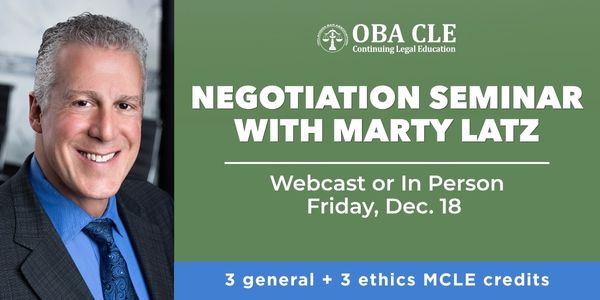
Negotiation is a skill lawyers use every day, but even experienced negotiators can benefit from a new strategy. Join nationally recognized negotiation expert Martin Latz for a practical, two-part seminar designed to sharpen your negotiation skills and give you a competitive edge on Friday, Dec. 18, in person or via webcast.
The morning session will cover proven techniques for building leverage, overcoming impasses, managing deadlines and knowing when to hold or fold. In the afternoon, explore how to harness AI to improve negotiation strategies, strengthen research and achieve better outcomes. With insights drawn from training more than 200,000 professionals worldwide, Mr. Latz offers actionable tools you can put to work immediately in your practice.

Featured CLE



Law Practice Tips | Phishing Alert for Law Firms: When the Sender Looks Legitimate
By OBA Management Assistance Program Director Julie Bays

Over the past several days, my work email account has been flooded with phishing messages that look surprisingly legitimate. They appear to come from familiar services such as Microsoft 365, Zoom, SharePoint and other business platforms. Some announce that a document has been shared, others claim that a voicemail is waiting, and still others reference payments or meeting invitations. Several have made it past our organization’s spam filter, although Outlook has been catching them in my junk email folder.
What makes these messages particularly concerning is how convincing they have become. We have long advised people to check the sender’s email address before clicking a suspicious link. However, when I examined one of the Zoom messages, the sender’s address appeared to be no-reply@zoom.us, an actual address used by Zoom.
Unfortunately, even a legitimate email address is no longer a guarantee that the message is safe.
Cybercriminals can fake a legitimate email address, but they can also misuse real features in trusted services, such as a genuine Zoom or SharePoint notification, to send fraudulent messages. In some cases, these emails actually come from the legitimate company’s systems. Microsoft recently reported detecting approximately 129 million malicious messages spoofing the sender domains of legitimate business services during the third quarter of 2026.
For lawyers and their staff, this presents a serious concern. We routinely receive electronic documents, payment notifications, meeting invitations and communications from clients and other professionals. A convincing phishing email could lead someone to disclose Microsoft 365 credentials, download malicious software or authorize a fraudulent payment. Any of these could threaten client confidentiality or the firm’s finances.
The best protection is to verify unexpected communications independently, even when they appear to come from a trusted source. Rather than clicking a link to review a supposedly shared document or listen to a voicemail, open the service directly through its website or application. If a payment request or document seems unusual, contact the sender using a phone number or email address you already know is legitimate.
Law firms should also encourage employees to report suspicious emails to their IT provider or administrator rather than simply deleting them. One employee’s suspicious message may be part of a larger attack against the firm.
Phishing emails are becoming harder to recognize, and the familiar warning signs are not always present. A little skepticism, particularly when an unexpected message asks you to click a link, open a document or provide credentials, remains one of the best ways to protect your practice and your clients.
The Oklahoma Bar Journal is a publication of the Oklahoma Bar Association. All rights reserved. Copyright© 2026 Oklahoma Bar Association. Statements or opinions expressed herein are those of the authors and do not necessarily reflect those of the Oklahoma Bar Association, its officers, Board of Governors, Board of Editors or staff. Although advertising copy is reviewed, no endorsement of any product or service offered by any advertisement is intended or implied by publication. Advertisers are solely responsible for the content of their ads, and the OBA reserves the right to edit or reject any advertising copy for any reason. Legal articles carried in the Oklahoma Bar Journal are selected by the Board of Editors. Information about submissions can be found at www.okbar.org.