
Vol. 6 No. 43 | Oct. 28, 2026


Courts
Supreme Court of Oklahoma
- 2026 OK 77: HUTZEL, ET AL. v. CITY OF NORMAN
Court of Criminal Appeals
No published opinions this week.
Court of Civil Appeals
No published opinions this week.
Dispositions Other than by Published Opinions
The Supreme Court of Oklahoma Court Calendar
The Supreme Court of Oklahoma is in session year round, unless otherwise noted. The court regularly schedules conferences on Mondays and other days as needed.
Member Transitions









More
Annual Meeting Event Highlight: Delegates Breakfast
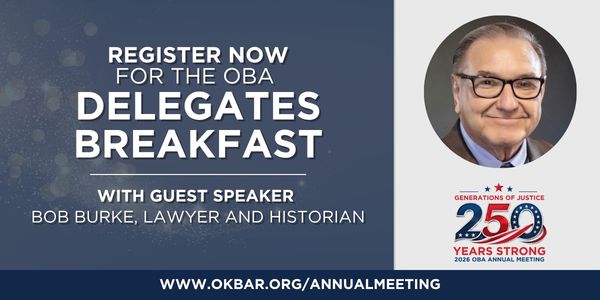
Lawyer and historian Bob Burke will join us as the guest speaker during the 2026 Delegates Breakfast on Friday, Nov. 13. Mr. Burke is an author with more historical nonfiction books than anyone else in history. He was born in Broken Bow and now practices constitutional law in Oklahoma City. Four of his books have won the Oklahoma Book Award and four have been nominated for the Pulitzer Prize.
Tickets to this program are free for delegates and $45 for nondelegates and alternates, available individually or as an add-on to your Annual Meeting registration.
Notice of Proposed Resolution

A resolution will be submitted to the House of Delegates at the 122nd Oklahoma Bar Association Annual Meeting at 10 a.m. Friday, Nov. 13, 2026, at the Skirvin Hilton Hotel in Oklahoma City. The resolution pertains to an Amendment to the Bylaws Adding Additional Judges as Oklahoma Judicial Conference Representatives to the OBA House of Delegates. The full text is available for viewing on the OBA website. (See "Items for Consideration" included under "Bar Business.")
House of Delegates Notice of Meetings
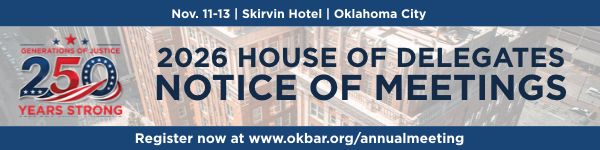
The 2026 Annual Meeting notice of meetings for the Credentials Committee, Rules and Bylaws Committee, Resolutions Committee and Tellers Committee has been posted. The Credentials Committee will meet Thursday, Nov. 12, at 9 a.m. The Rules and Bylaws Committee will meet Thursday, Nov. 12, at 10 a.m. The Resolutions Committee will meet Thursday, Nov. 12, at 10:45 a.m. The Tellers Committee will meet Friday, Nov. 13, at 11 a.m.
Due Process and Requests for Affirmative Relief Within the Oklahoma Tax Commission
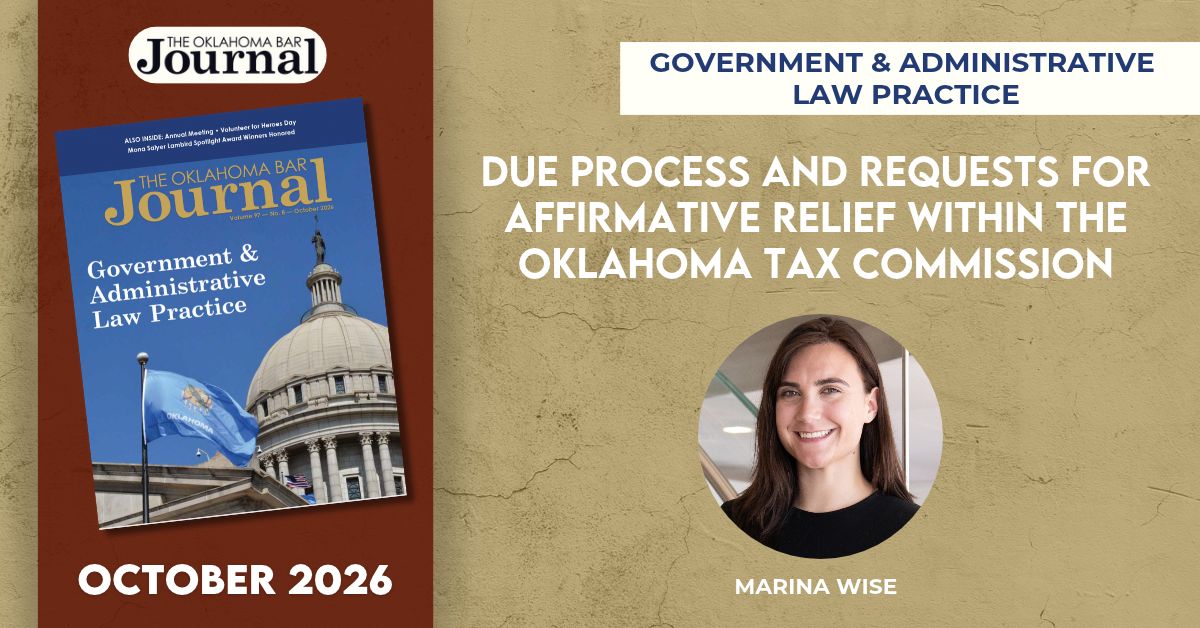
"From tax assessments to claims for exemption, many Oklahoma Tax Commission (OTC) decisions will have a direct financial impact on taxpayers. Occasionally, taxpayers may disagree with the OTC’s conclusion. Accordingly, the OTC is permitted to hold hearings on tax issues and otherwise review its previous decisions. For purposes of this article, these methods can be collectively referred to as the OTC’s administrative procedures for disputes and claims for relief (agency review system)."
Oklahoma’s Errant Functionalist Separation of Powers Approach
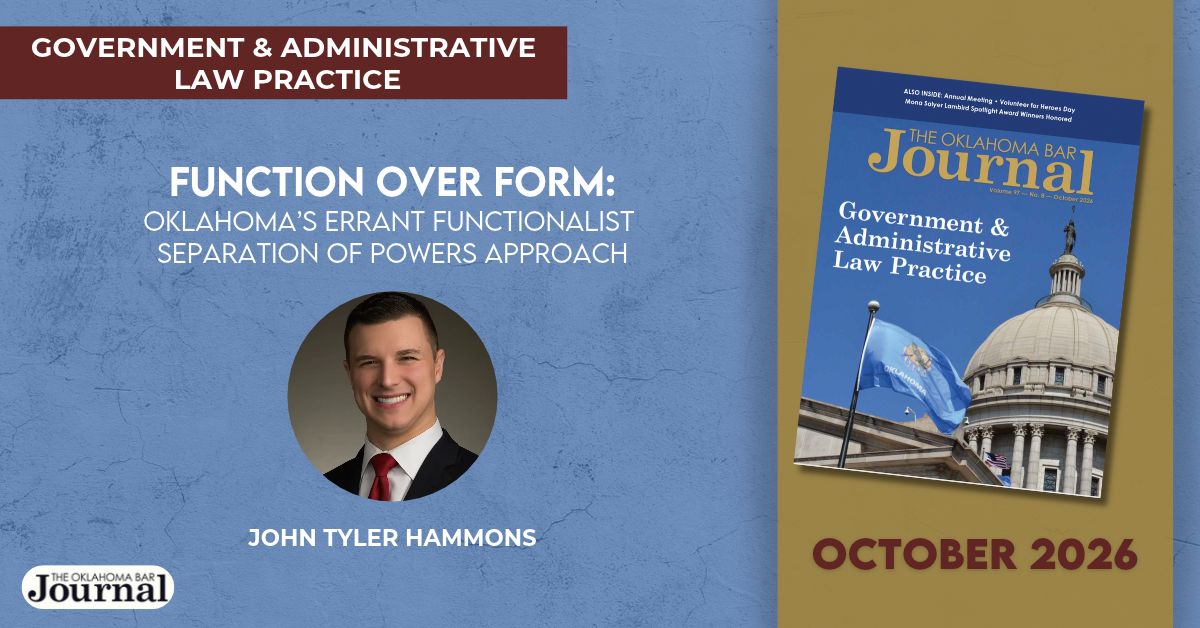
"The late U.S. Supreme Court Justice Antonin Scalia once observed the true genius of the American constitutional experiment was found not in the 'marvelous provisions' of the Bill of Rights but, rather, in 'the structure of our government.' Without a structure sufficient to 'prevent the concentration of power,' those marvelous provisions become mere 'parchment guarantees.' Despite this warning, Oklahoma’s constitutional structure has not been enforced with a zeal Justice Scalia would admire. Stemming from the cases of In re the Application of the Oklahoma Department of Transportation, Series 2002 (ODOT I) and In re the Application of the Oklahoma Department of Transportation, Series 2003 (ODOT II), collectively the 'ODOT bonds cases,' Oklahoma has adopted a functional, rather than formal, approach to deciding separation of powers questions. Unfortunately for liberty, this approach lacks sufficient safeguards to prevent the concentration of power."
Oklahoma Bar Foundation | OBF Site Visits Reconnect With Grantees Across Oklahoma

"For years, the Oklahoma Bar Foundation’s grantee site visits were one of the most valuable parts of our operations. Sadly, COVID-19 paused that practice. In 2025, we started getting back out on the road, and we’ve kept that momentum going in 2026. There is tremendous value in sitting across the table from the amazing people executing critical efforts in their community and hearing about, in their own words, what’s going well and what other opportunities we have to assist."
The Back Page | Court Has Gone to the Dogs

"Therapy dogs are different than other assistance animals, such as service dogs or emotional support animals. Therapy animals are trained to interact with a variety of people in stressful and emotions situations to provide comfort and alleviation of anxiety which specifically includes physical interaction, including petting and talking to the dog. Conversely, service animals are trained to assist a specific person with specific disability, and emotional support animals are trained to provide a specific person with comfort and emotional support, and interaction between the dog and a third party is not permitted."
YLD Proposes Changes To Its Bylaws

The OBA Young Lawyers Division has proposed changes to its bylaws pertaining to leadership composition and the election processes. These amendments will be considered and voted upon by the YLD at 4 p.m. on Thursday, Nov. 12, in conjunction with the Annual Meeting at the Skirvin Hotel in Oklahoma City. Adoption of the proposed changes requires a two-thirds vote of members present and voting. If adopted by the YLD, the proposed changes must be ratified by the OBA Board of Governors and will take effect Jan. 1, 2027.
A summary of the proposed changes follows.
- Single Election Cycle for Directors (Ends Staggered Elections)
Instead of electing directors across alternating even- and odd-year cycles, all 20 directors will be elected together every two years, in even-numbered years. A one-time transition consolidates the cycle at the 2026 Annual Meeting, and current directors are eligible to stand for election. (Sections 3.3, 3.4, 3.8, 5.1, 5.4) - Conforming Election/Officer Fixes
With annual director elections gone, the secretary and treasurer eligibility language and the Nominating Committee provisions were updated so they function under the consolidated cycle. The Nominating Committee’s selection timing and neutrality rule were also cleaned up. (Sections 4.2.3, 4.2.4, 5.2) - Executive Board Seats
A director who moves onto the Executive Board – as chairperson-elect, chairperson, secretary, treasurer, or immediate past-chairperson – automatically vacates his or her underlying district or at-large seat, which is then filled for the balance of the term. (Section 4.6) - Board Meeting Agendas
The chairperson will prepare and circulate an agenda with the meeting notice. The agenda is advisory – the board may still take up matters not listed. (Section 3.6) - Law-School Ex-Officio Members
These positions now carry a one-year term tied to each law school’s own academic calendar (rather than our calendar year), which accommodates schools with different start and end dates. Final-year (3L) students are expressly eligible and encouraged to build a pipeline of members who stay involved after graduation. Service ends automatically on graduation or loss of enrollment, with the dean able to name a replacement, and prior ex-officio service does not count against a person’s eligibility for elected board seats. (Section 3.1(c)) - Clarifications and Cleanup
The immediate past-chairperson’s role as a board member is confirmed, and a minor grammatical gap in the membership-eligibility provision was corrected. (Sections 2.1, 4.2.5)

Featured CLE


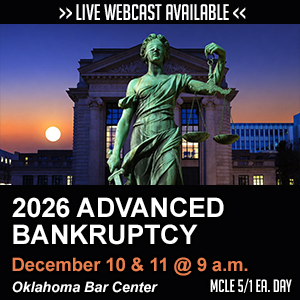

Pro Bono Doesn’t Have to Mean Taking Another Case
By OBA Management Assistance Program Director Julie Bays

Oct. 25-31 is the ABA’s National Celebration of Pro Bono, a time to recognize the lawyers who volunteer their services and encourage others to participate. This year’s theme is Serving Justice. Strengthening Democracy.
In her October Oklahoma Bar Journal message, “Pro Bono: A Promise of Justice for All,” OBA President Amber Peckio reminds us that providing legal assistance to those who cannot afford it is an important part of our profession. She also highlights several opportunities for Oklahoma lawyers to make a difference.
For busy solo and small firm lawyers, the thought of accepting another case without compensation may seem overwhelming. But pro bono service doesn’t always require a substantial commitment of time. Sometimes, answering a legal question, reviewing a document or helping someone understand their options can make an enormous difference.
One particularly convenient opportunity is Oklahoma Free Legal Answers, a virtual legal advice clinic where qualifying Oklahomans can submit civil legal questions for volunteer attorneys to answer online. Lawyers can volunteer when their schedules permit, without leaving their offices. Users choose a category, such as family, housing or consumer debt, and describe their situation. Volunteer lawyers can log in at any time, browse questions by topic and read the full question before deciding whether to take it. Once you select a question, you have three days to respond, and you can ask follow-up questions if you need more information. You provide information and basic legal advice without any expectation of ongoing representation, and the ABA provides malpractice insurance for volunteers.
Another approach is to consider providing limited scope legal services. Rather than representing someone throughout an entire legal matter, a lawyer might agree to provide advice, prepare a document or assist with a particular part of the case. Limited scope representation can also be a practical way to make paid legal assistance more affordable for clients who cannot afford full representation. The OBA Management Assistance Program maintains a Limited Scope Legal Services resource page with sample agreements, practical guidance and other materials for lawyers interested in this approach.
Pro bono service doesn’t have to be complicated or time-consuming. Whether you volunteer at a legal clinic, answer questions online or help with one specific legal problem, even a small commitment of your time can help someone who might otherwise have nowhere to turn.
The Oklahoma Bar Journal is a publication of the Oklahoma Bar Association. All rights reserved. Copyright© 2026 Oklahoma Bar Association. Statements or opinions expressed herein are those of the authors and do not necessarily reflect those of the Oklahoma Bar Association, its officers, Board of Governors, Board of Editors or staff. Although advertising copy is reviewed, no endorsement of any product or service offered by any advertisement is intended or implied by publication. Advertisers are solely responsible for the content of their ads, and the OBA reserves the right to edit or reject any advertising copy for any reason. Legal articles carried in the Oklahoma Bar Journal are selected by the Board of Editors. Information about submissions can be found at www.okbar.org.