
Vol. 6 No. 42 | Oct. 21, 2026


Courts
Supreme Court of Oklahoma
Court of Criminal Appeals
No published opinions this week.
Court of Civil Appeals
No published opinions this week.
Dispositions Other than by Published Opinions
The Supreme Court of Oklahoma Court Calendar
The Supreme Court of Oklahoma is in session year round, unless otherwise noted. The court regularly schedules conferences on Mondays and other days as needed.
Member Transitions









More
Annual Meeting Early-Bird Registration Deadline Is Today!
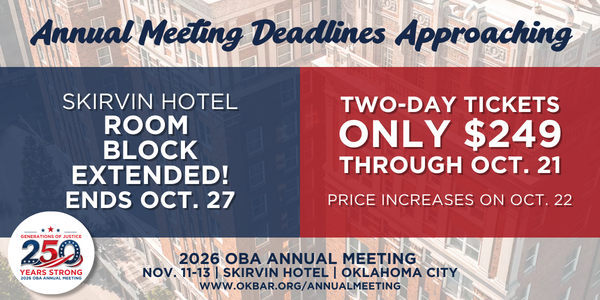
Today is the early-bird deadline for Annual Meeting registration! There are only a few hours left to save on Annual Meeting registration. Two-day tickets for Annual Meeting are only $249. With a two-day ticket, you can receive 11 hours MCLE including 2 hours ethics, allowing you to earn almost all your MCLE credits for the year. After today, the price increases. Learn and earn MCLE credits, hear from dynamic speakers, network with colleagues and law school friends, and have some fun too!
The Annual Meeting hotel room block at the Skirvin Hotel has been extended Oct. 27. To take advantage of the OBA room rate, book online or by phone at 1-800-HILTONS and mention the Oklahoma Bar Association 2026 Conference (or group code 93R).
This year’s meeting will give OBA members a chance to hear from engaging speakers, earn MCLE credits, get involved with bar business and network with colleagues. We are excited for you to join us for this year's Annual Meeting, set for Nov. 11-13 at the historic Skirvin Hotel, located at One Park Ave. in Oklahoma City.
Annual Meeting Event Highlight | OBA Annual Luncheon
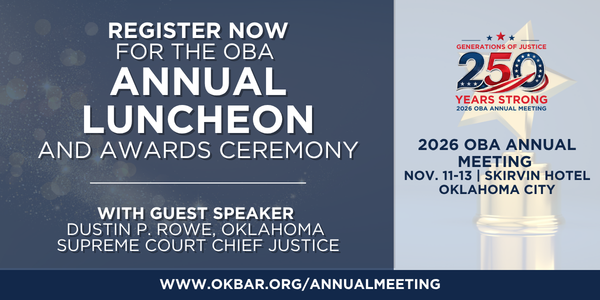
The OBA Annual Luncheon is a longstanding tradition where attendees hear from inspiring speakers and recognize OBA Award winners. At this year’s Annual Luncheon, you’ll hear from Oklahoma Supreme Court Chief Justice Dustin P. Rowe and honor the attorneys and organizations receiving OBA Awards. Tickets are $85 and are available individually or as an add-on to your Annual Meeting registration. The luncheon is sponsored by the OBA Family Law Section.
Notice of Proposed Resolution

A resolution will be submitted to the House of Delegates at the 122nd Oklahoma Bar Association Annual Meeting at 11 a.m. Friday, July Nov. 13, 2026, at the Skirvin Hilton Hotel in Oklahoma City. The resolution pertains to an Amendment to the Bylaws Adding Additional Judges as Oklahoma Judicial Conference Representatives to the OBA House of Delegates. The full text is available for viewing on the OBA website. (See "Items for Consideration" included under Bar Business.")
Public Construction Under the Oklahoma Public Competitive Bidding Act

"The Public Competitive Bidding Act of 1974 applies to public agencies, including the state of Oklahoma, and its political subdivisions such as counties, cities, towns, and school districts. This article addresses only those provisions of the act that apply to public construction contracts for municipalities.
Municipal officials function as trustees of public funds. The act is designed to promote open competition and to guard against 'favoritism, improvidence, extravagance, fraud and corruption,' while securing 'the best work or supplies at the lowest price practicable.' Its 'sole purpose is to obtain the best results at the lowest cost, the greatest value for the fewest dollars; in other words, it is a means for making the best possible bargain.'"
Efficiency and the Open Records Act
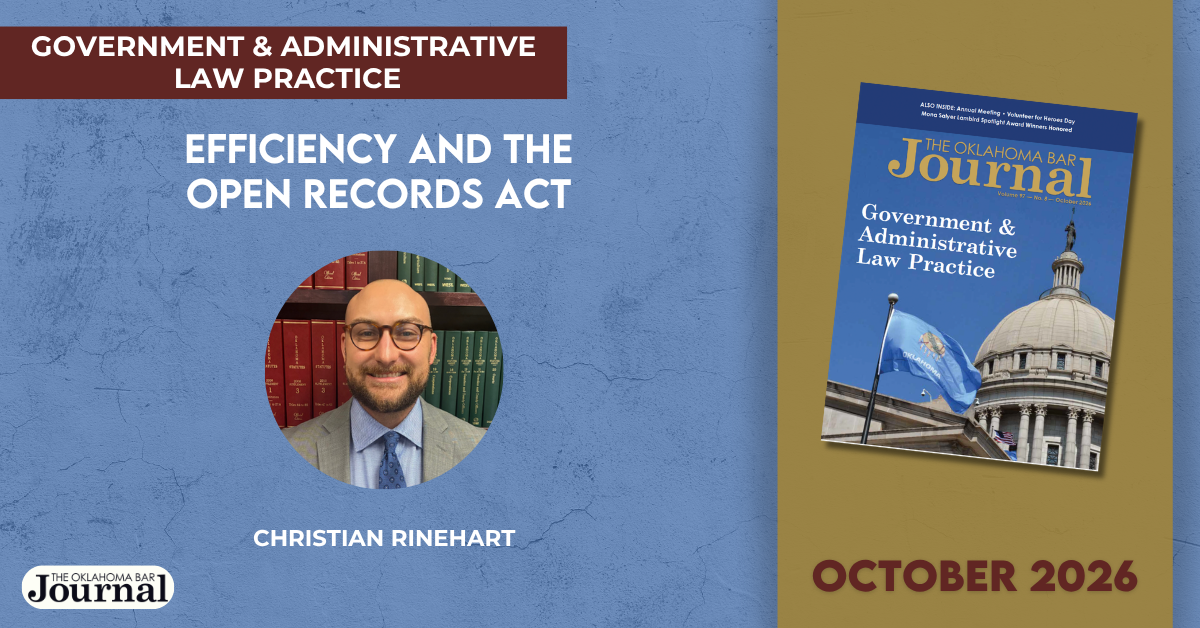
"The Oklahoma Open Records Act (ORA) has the paramount goal of ensuring that all political power is inherent in the people. In fact, the purpose of the ORA states that 'it is the public policy of the State of Oklahoma that the people are vested with the inherent right to know and be fully informed about their government.' This sentiment can be boiled down to one word: transparency. The American revolutionary Patrick Henry stated the importance of transparency as follows: 'The liberties of a people never were, nor ever will be, secure, when the transactions of their rulers may be concealed from them.' Oklahoma, like other states and the federal government, recognizes that transparency in government is important, and the ORA is designed to ensure the public can be informed about governmental operations while allowing public bodies to adopt reasonable procedures that protect record integrity and prevent excessive disruption of essential functions. While transparency in government is undoubtedly important in Oklahoma, recent statutory changes and case law developments continue to shape how the ORA is administered in a manner that seeks to balance transparency with the efficient use of public resources and taxpayer dollars."
Law Practice Tips | Who Has the Keys to Your Law Firm’s Technology?

"Most lawyers would never allow an outside bookkeeper to be the only person who could access the firm’s bank accounts. The bookkeeper may handle the day-to-day work, but the lawyer understands that the accounts belong to the firm and that the firm must retain ultimate control. Technology should be treated the same way.
Your law firm may pay every technology bill. You may own the computers sitting on the desks. You may pay monthly subscriptions for Microsoft 365 or Google Workspace, practice management software, cloud storage, your telephone system and numerous other services. But if the person or company managing your technology disappears tomorrow, could you get into all of them?"
YLD Proposes Changes To Its Bylaws

The OBA Young Lawyers Division has proposed changes to its bylaws pertaining to leadership composition and the election processes. These amendments will be considered and voted upon by the YLD at 4 p.m. on Thursday, Nov. 12, in conjunction with the Annual Meeting at the Skirvin Hotel in Oklahoma City. Adoption of the proposed changes requires a two-thirds vote of members present and voting. If adopted by the YLD, the proposed changes must be ratified by the OBA Board of Governors and will take effect Jan. 1, 2027.
A summary of the proposed changes follows.
- Single Election Cycle for Directors (Ends Staggered Elections)
Instead of electing directors across alternating even- and odd-year cycles, all 20 directors will be elected together every two years, in even-numbered years. A one-time transition consolidates the cycle at the 2026 Annual Meeting, and current directors are eligible to stand for election. (Sections 3.3, 3.4, 3.8, 5.1, 5.4) - Conforming Election/Officer Fixes
With annual director elections gone, the secretary and treasurer eligibility language and the Nominating Committee provisions were updated so they function under the consolidated cycle. The Nominating Committee’s selection timing and neutrality rule were also cleaned up. (Sections 4.2.3, 4.2.4, 5.2) - Executive Board Seats
A director who moves onto the Executive Board – as chairperson-elect, chairperson, secretary, treasurer, or immediate past-chairperson – automatically vacates his or her underlying district or at-large seat, which is then filled for the balance of the term. (Section 4.6) - Board Meeting Agendas
The chairperson will prepare and circulate an agenda with the meeting notice. The agenda is advisory – the board may still take up matters not listed. (Section 3.6) - Law-School Ex-Officio Members
These positions now carry a one-year term tied to each law school’s own academic calendar (rather than our calendar year), which accommodates schools with different start and end dates. Final-year (3L) students are expressly eligible and encouraged to build a pipeline of members who stay involved after graduation. Service ends automatically on graduation or loss of enrollment, with the dean able to name a replacement, and prior ex-officio service does not count against a person’s eligibility for elected board seats. (Section 3.1(c)) - Clarifications and Cleanup
The immediate past-chairperson’s role as a board member is confirmed, and a minor grammatical gap in the membership-eligibility provision was corrected. (Sections 2.1, 4.2.5)

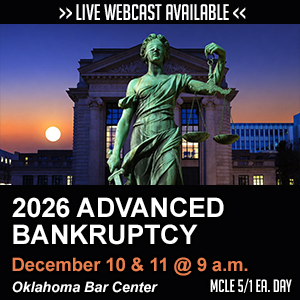
Featured CLE



Closing the Case
By OBA Management Assistance Program Director Julie Bays
 How many open client files does your law office have? More importantly, how many of those files should still be open?
It’s easy for completed matters to remain on the active file list. Perhaps the case was dismissed, the divorce decree was entered, or the estate was finally distributed. The legal work is finished, but nobody officially closed the file. In a busy small firm, file closing can easily become one of those administrative tasks that gets postponed indefinitely.
Periodically reviewing open matters is a good practice management habit. It can reveal cases that need attention, unfinished tasks, outstanding client balances and matters that are ready to be closed. But closing a file should involve more than changing its status in your practice management software or moving a folder into storage.
DON'T FORGET THE CLOSING LETTER
A closing letter is one of the simplest and most useful communications a lawyer can send. It confirms that the representation has concluded, reminds the client of any remaining responsibilities and provides an opportunity to return original documents and deliver a final accounting. It can also briefly remind the client of other types of legal matters the firm handles, so the client knows whom to call when another legal need arises.
It also helps eliminate confusion about whether the lawyer continues to represent the client. A client who hasn’t heard from the lawyer in several months may assume the lawyer is still monitoring the matter or will remind them of future deadlines.
HOW LONG MUST YOU KEEP CLOSED FILES?
Oklahoma’s Rules of Professional Conduct do not establish a general retention period for closed client files. However, ORPC 1.15(a) requires lawyers to preserve complete records of client trust funds and other client property for five years after termination of the representation.
That doesn’t mean every file can automatically be destroyed after five years. Certain matters, including probate, estate planning, guardianships, adoptions and cases involving minors, may require longer retention because of the nature of the representation, applicable law or the continuing significance of documents. Lawyers should also consider applicable statutes of limitations and their professional liability carrier’s recommendations.
For a more detailed discussion, including sample file retention language and a closing letter, I recommend Jimmy Oliver’s Oklahoma Bar Journal article, A Guide to File Retention and Destruction.
The Oklahoma Bar Journal is a publication of the Oklahoma Bar Association. All rights reserved. Copyright© 2026 Oklahoma Bar Association. Statements or opinions expressed herein are those of the authors and do not necessarily reflect those of the Oklahoma Bar Association, its officers, Board of Governors, Board of Editors or staff. Although advertising copy is reviewed, no endorsement of any product or service offered by any advertisement is intended or implied by publication. Advertisers are solely responsible for the content of their ads, and the OBA reserves the right to edit or reject any advertising copy for any reason. Legal articles carried in the Oklahoma Bar Journal are selected by the Board of Editors. Information about submissions can be found at www.okbar.org.